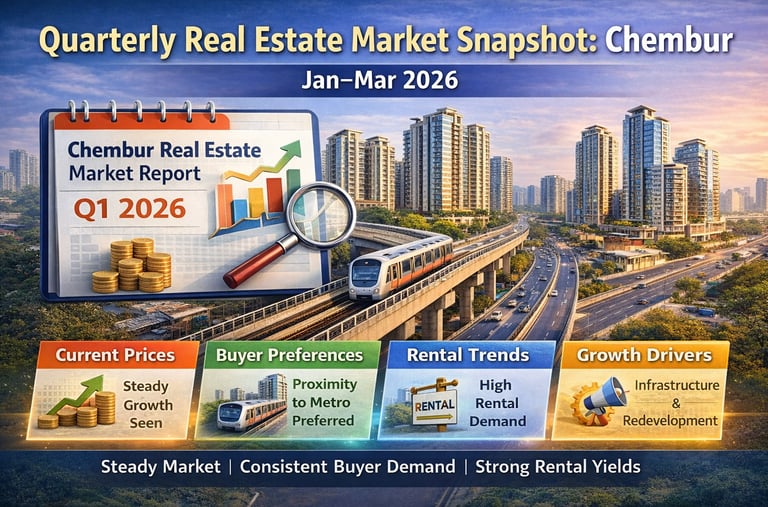
Quarterly Real Estate Market Snapshot: Chembur (Jan–Mar 2026)
The first quarter of 2026 has reinforced Chembur’s position as one of Mumbai’s most stable and high-demand residential markets. Backed by strong infrastructure, sustained redevelopment activity, and consistent end-user demand, Chembur’s real estate market showed healthy momentum between January and March 2026. This quarterly snapshot highlights key price trends, buyer sentiment, demand drivers, and what lies ahead for property buyers and investors.
1/14/20262 min read
Market Overview: Q1 2026 Performance
During the January–March 2026 period, Chembur experienced steady residential absorption across mid-segment and premium housing. Buyer activity remained strong, particularly for ready-to-move and near-completion projects. Developers focused on smaller inventory releases rather than aggressive new launches, helping maintain price stability.
Average residential property prices in Chembur continued on an upward but controlled trajectory, reflecting genuine end-user demand rather than speculative buying. Both Chembur East and Chembur West saw consistent inquiries, with micro-markets close to metro corridors and arterial roads attracting higher interest.
Current Property Price Trends in Chembur
In Q1 2026, property prices in Chembur varied depending on project type, location, and amenities.
Mid-segment residential projects recorded stable pricing with marginal appreciation compared to the previous quarter. Premium and luxury developments, especially those offering modern amenities, larger layouts, and superior connectivity, continued to command higher rates.
Redeveloped projects remained in high demand, as buyers showed a clear preference for newer buildings with enhanced safety, parking, and lifestyle features. Limited supply of quality housing stock further supported price firmness across the suburb.
Buyer Demand and Preferences
Buyer sentiment in Chembur during the first quarter of 2026 was predominantly end-user driven. Families, professionals, and long-term investors actively sought properties that offer a balance between connectivity, liveability, and future appreciation.
Key buyer preferences included:
Well-planned 1 BHK and 2 BHK apartments for self-use
Proximity to metro stations and major road networks
Redevelopment projects with modern amenities
Homes offering good rental yield potential
The demand for compact, efficiently designed homes remained strong, particularly among first-time buyers and working professionals employed in BKC, Lower Parel, and South Mumbai.
Rental Market Snapshot: Jan–Mar 2026
Chembur’s rental market continued to perform well in Q1 2026. Rental values remained stable with slight upward movement in well-connected pockets. Properties near railway stations, metro corridors, and business hubs recorded faster tenant absorption.
The demand for furnished and semi-furnished apartments increased, especially among corporate tenants and relocated professionals. Investors benefited from consistent rental yields, making Chembur an attractive option for income-focused buyers.
Key Growth Drivers in Q1 2026
Several factors influenced Chembur’s real estate performance during the quarter:
Infrastructure and Metro Connectivity
Ongoing metro developments and improved last-mile connectivity played a major role in sustaining buyer interest. Improved commute times continue to enhance Chembur’s appeal as a centrally connected suburb.
Redevelopment Momentum
The steady pace of redevelopment projects contributed to supply of modern housing while also pushing up overall market value. New launches focused on lifestyle upgrades rather than volume sales.
Limited New Supply
With fewer large land parcels available, supply remained controlled, helping maintain price stability and preventing market saturation.
Outlook for the Next Quarter (Apr–Jun 2026)
Looking ahead, Chembur’s real estate market is expected to remain resilient in the coming quarter. Price growth is likely to stay moderate, supported by infrastructure progress and sustained end-user demand.
Developers may introduce selective new launches in redevelopment projects, while buyers can expect limited but high-quality inventory. Rental demand is also projected to remain strong, particularly for smaller configurations.
For investors, Chembur continues to offer a balanced proposition of capital appreciation and rental income, while homebuyers benefit from long-term value and lifestyle convenience.
Conclusion
The January–March 2026 quarter highlighted Chembur’s strength as a mature yet growing real estate market. Stable prices, strong buyer confidence, and ongoing redevelopment have positioned Chembur as a reliable choice for both homebuyers and investors. As infrastructure developments progress and demand remains consistent, Chembur is set to continue its steady growth through 2026.