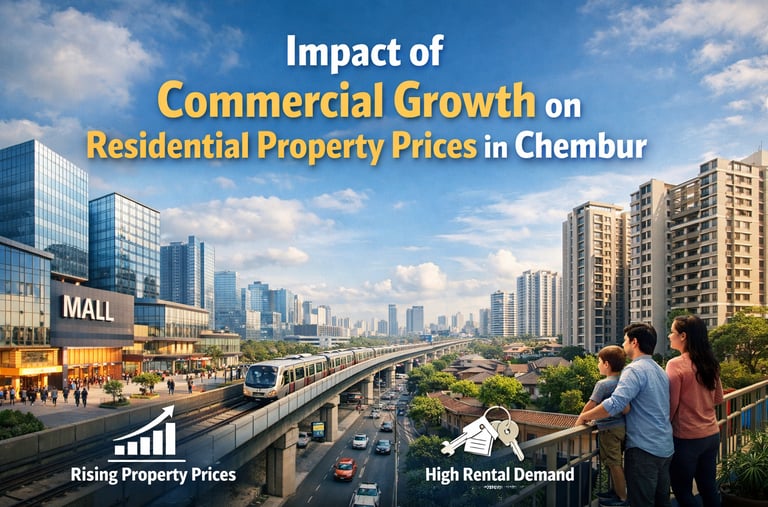
Impact of Commercial Growth on Residential Property Prices in Chembur
Chembur’s real estate market has been drawing significant attention from homebuyers, tenants, and investors alike. Once known predominantly as a residential suburb, Chembur has gradually evolved into a balanced urban hub with growing commercial activity. The expansion of commercial office spaces, retail centres, and corporate establishments in and around Chembur is increasingly influencing residential property prices. In 2026, the suburb stands at an inflection point where commercial growth and residential demand are shaping new pricing dynamics, offering both opportunities and considerations for prospective buyers and investors.
2/14/20263 min read
Commercial Growth as a Catalyst for Residential Demand
Commercial development in and around Chembur has historically played a key role in driving demand for nearby residential properties. As businesses establish offices, coworking spaces, and retail outlets in the vicinity, employment options increase, attracting professionals who prefer living closer to their workplace. This proximity reduces commute times, enhances work-life balance, and makes certain localities highly desirable for residential living.
Demand from working professionals, particularly from sectors such as IT, finance, healthcare, and service industries, contributes to sustained interest in rental and purchase markets. As a result, residential properties in commercial corridors often experience stronger price growth compared to areas farther away from employment hubs.
Connectivity and Commercial Nodes Boost Residential Value
Good connectivity is a major factor that amplifies the impact of commercial growth on property prices. Chembur’s growing road network, improved transit options, and expanding metro connectivity have made it easier to travel to business districts like BKC, Lower Parel, and central Mumbai. The arrival of commercial establishments and easy access to transit routes amplify the suburb’s appeal.
Localities in close proximity to transit hubs and commercial complexes often command a premium due to their strategic location advantage. Residential properties near corporate centres and main road access points typically benefit from higher demand, which translates to deeper price appreciation.
Retail and Lifestyle Infrastructure Drives Liveability Interest
Commercial growth is not limited to office spaces. The development of retail centres, supermarkets, restaurants, cafes, and entertainment venues enhances the overall liveability of Chembur. Modern lifestyles often prioritise convenience, walkability, and access to social amenities — factors which greatly influence residential property values.
Neighbourhoods with thriving commercial nodes offer residents easy access to lifestyle features that reduce the need for long commutes to fulfill daily needs. This has a positive impact on property desirability, particularly among families and young professionals seeking a balanced urban lifestyle.
Rental Market Dynamics Strengthened by Commercial Expansion
Alongside ownership demand, rental markets in Chembur are also shaped by commercial growth. Corporate employees, short-term assignees, and relocated professionals frequently seek rental accommodation close to business centres. This sustained rental demand supports stronger rental yields in localities near commercial hubs.
Higher rental activity, combined with lower vacancy rates, encourages investors to acquire residential properties in these zones. As investor demand increases, price appreciation often follows, reinforcing the upward trend in property values.
Influence on Micro-Location Pricing Patterns
Commercial growth does not affect all areas of Chembur uniformly. Micro-locations that are closer to key commercial zones — such as near transit corridors, business parks, and shopping districts — tend to witness stronger pricing momentum. Localities like Chembur East near transit nodes, areas close to arterial routes, and those adjacent to emerging commercial developments often outperform other neighbourhoods in terms of property price growth.
Micro-locations with limited supply yet strong commercial connectivity are particularly attractive, as they combine convenience with better long-term value prospects.
Risk Considerations and Balanced Growth
While commercial expansion generally supports residential property appreciation, it is important for buyers and investors to consider balanced growth patterns. Overcrowding, traffic congestion, and infrastructure strain are potential challenges in rapidly commercialising areas. Sustainability of commercial growth and infrastructure upgrades are essential to ensure that residential liveability is not compromised.
Buyers should also consider long-term supply dynamics, upcoming developments, and neighbourhood planning when evaluating investment decisions.
Conclusion
The impact of commercial growth on residential property prices in Chembur is clearly visible in both price appreciation and rental demand. As commercial activity expands, well-connected neighbourhoods with strong transport links and lifestyle amenities continue to outperform in terms of property value. Professionals seeking shorter commutes, families prioritising liveability, and investors seeking rental income are all contributing to robust demand in these zones.
For homebuyers and investors in 2026, understanding the interplay between commercial growth and residential real estate fundamentals in Chembur can lead to smarter, future-oriented property decisions. With balanced development and resilient demand drivers, Chembur remains one of Mumbai’s most compelling residential markets.