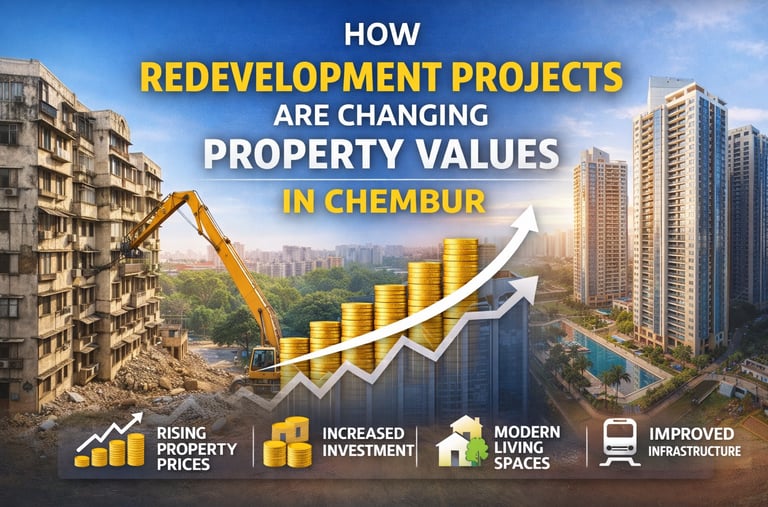
How Redevelopment Projects Are Changing Property Values in Chembur
Chembur’s real estate landscape is evolving rapidly, propelled by extensive redevelopment activity that is reshaping neighbourhoods and redefining property values. Once characterised by low-rise buildings and older housing stock, the suburb is now witnessing a surge in modern high-rise projects with contemporary amenities, enhanced space utilisation, and improved design standards. This shift is not only transforming how residents live but also influencing property values across Chembur. In 2026, redevelopment continues to be a key driver of price appreciation, investment interest, and market confidence.
2/12/20263 min read
The Redevelopment Wave in Chembur
Redevelopment refers to replacing older, dilapidated structures with modern residential developments that offer better safety features, efficient layouts, and lifestyle amenities. In Chembur, many cooperative housing societies and older walk-ups are undergoing redevelopment due to rising demand for modern living spaces and increasing land values. This has set off a ripple effect across the real estate market, altering both buyer behaviour and investor sentiment.
Projects replacing outdated buildings with multi-storey towers with enhanced facilities are breathing new life into several pockets of Chembur. These developments improve the suburb’s urban fabric while maintaining community continuity, making them highly attractive to end users and investors alike.
Redevelopment and Property Price Appreciation
One of the most visible effects of redevelopment in Chembur is the rise in property prices. Areas undergoing redevelopment tend to experience stronger property value growth compared to pockets with older housing stock. This is because newly developed projects often command a premium due to better construction quality, enhanced safety norms, and modern amenities such as fitness centres, landscaped gardens, and advanced security systems.
Buyers are increasingly willing to pay higher rates for homes in redeveloped complexes, particularly in transit-oriented locations or near key infrastructure nodes. As redevelopment improves the urban appeal of such areas, demand rises, pushing property values upward. In a market like Chembur, where space is limited and demand remains high, redevelopment acts as a key differentiator in price performance.
Increased Investment and Buyer Confidence
Redevelopment projects also boost investment interest in Chembur. Investors often view redeveloped properties as less risky and more future-ready because they offer modern infrastructure and lower maintenance concerns in the initial years after completion. As a result, redeveloped homes typically attract both long-term investors seeking capital appreciation and short-term investors interested in rental returns.
The presence of redevelopment also signals confidence from developers and existing homeowners, who are willing to collaborate on modern projects to unlock land value. This has a positive impact on buyer sentiment, encouraging more transactions and contributing to an active market.
Improved Liveability and Tenant Demand
Redevelopment substantially enhances liveability, which in turn influences rental demand and occupancy rates. Modern residential complexes in Chembur feature larger and more efficient floor plans, better ventilation, parking solutions, building management systems, and additional lifestyle features.
These attributes appeal strongly to working professionals and families who seek comfortable living environments with contemporary conveniences. Higher tenant demand, particularly for one BHK and two BHK configurations in redeveloped projects, supports stronger rental yields — an important contributor to property value growth.
Infrastructure Synergy and Location Value
Redevelopment often aligns with broader infrastructure upgrades, which further enhances property values. In Chembur, ongoing and planned improvements in transport, roads, and community facilities complement redevelopment projects. Areas that combine redevelopment activity with proximity to transit corridors, arterial roads, and social infrastructure typically witness faster and more pronounced price appreciation.
The synergy between redevelopment projects and improved infrastructure amplifies Chembur’s appeal, reinforcing its position as a strong residential and investment market in Mumbai’s real estate ecosystem.
Balancing Old and New: A Market in Transition
While redevelopment brings many positives, it also poses challenges such as temporary relocation during construction and changes in neighbourhood dynamics. However, many redevelopment initiatives in Chembur are structured to minimise disruption, with residents often offered compensation, alternate accommodation, or options within the new development.
This balance between preserving community ties and embracing modernisation exemplifies how Chembur’s real estate market is transitioning without losing its residential character.
Conclusion
Redevelopment projects are a key force driving property value transformation in Chembur. By introducing modern housing solutions, enhancing liveability, encouraging investment, and aligning with key infrastructure developments, redevelopment is reshaping the suburb’s real estate landscape in 2026. Areas experiencing redevelopment tend to see stronger appreciation, higher rental demand, and improved buyer confidence.
Whether you are a first-time homebuyer, an investor, or someone planning to upgrade your residence, understanding how redevelopment influences property values is essential. Chembur’s redevelopment momentum is not just creating new homes — it is building a future-ready residential environment with long-term growth potential.