How Infrastructure Development Is Reshaping Mumbai’s Property Market
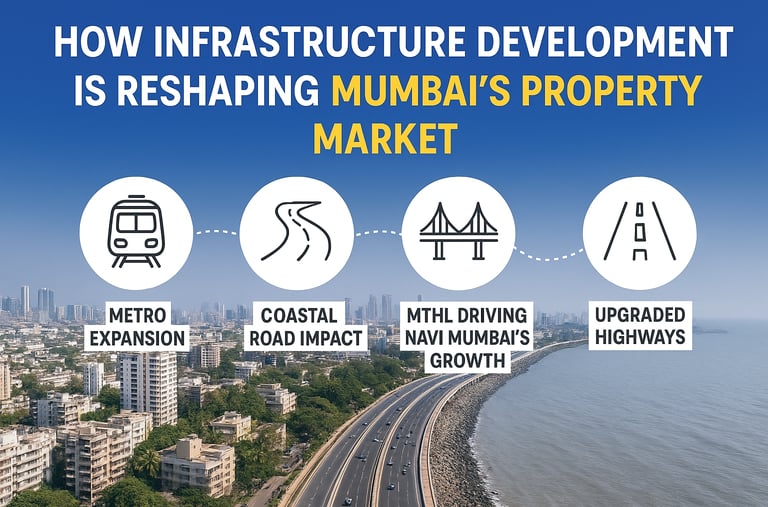
Mumbai’s real estate market has always been one of the most dynamic and sought-after in India, but in recent years, infrastructure development has become the strongest force driving property trends across the city. With large-scale projects such as new metro lines, the Coastal Road, the Mumbai Trans Harbour Link (MTHL), elevated highways, and upgraded arterial roads, Mumbai is experiencing a transformation that is directly influencing homebuyer preferences, demand patterns, and price appreciation. In 2025, infrastructure is not just enhancing connectivity—it is redefining the real estate landscape.
12/4/20252 min read
One of the most impactful developments is the Metro expansion. The new and upcoming metro corridors connecting Dahisar–Andheri–Goregaon, BKC–Chembur, Wadala–Thane, and Navi Mumbai have drastically reduced travel time across the city. Areas previously considered far from business districts are now growing rapidly due to improved accessibility. Localities like Andheri East, Goregaon, Powai, BKC, and Chembur have witnessed increased demand from both homebuyers and tenants because the metro offers a reliable, faster, and more affordable commuting alternative. For developers, proximity to a metro station has become a major selling point, and projects near metro routes are commanding higher premiums and faster sales.
Another game-changing project is the Mumbai Coastal Road. This ambitious initiative has significantly shortened travel time between key parts of South Mumbai and the western suburbs. The development has given a strong boost to luxury and premium micro-markets around Worli, Haji Ali, Breach Candy, Bandra, Khar, and Juhu. Reduced congestion, scenic connectivity, and smoother traffic movement have increased the desirability of these neighbourhoods. Buyers looking for upscale living with enhanced accessibility are showing renewed interest in sea-facing apartments, premium towers, and redeveloped properties along the coastal belt. Real estate experts predict that the full impact of the Coastal Road will continue to unfold over the next few years, further elevating prices in these prestigious markets.
Perhaps the most transformative infrastructure project for the larger region is the Mumbai Trans Harbour Link (MTHL), also known as the Atal Setu. Connecting South Mumbai to Navi Mumbai in under 30 minutes, the MTHL has opened huge development possibilities in emerging growth corridors such as Panvel, Ulwe, and Dronagiri. These areas, once considered far from the city, are now being viewed as prime investment destinations thanks to their improved accessibility, lower property prices, and upcoming commercial hubs like the Navi Mumbai International Airport. As a result, developers are launching large townships, plotted developments, and high-rise projects to meet the increasing demand. MTHL has also strengthened the appeal of Navi Mumbai as a major business district, creating a future where employment and residential growth go hand in hand.
Beyond these landmark projects, several other upgrades—such as the Santacruz–Chembur Link Road (SCLR) extension, the Eastern Freeway, the Goregaon–Mulund Link Road (GMLR), and ongoing road-widening initiatives—are improving east-west connectivity and reducing traffic congestion across the city. These enhancements are enabling buyers to consider areas that were previously overlooked due to long commute times. Suburbs like Mulund, Bhandup, Chembur, Wadala, Kandivali, and Borivali have witnessed steady appreciation as connectivity improves.
Overall, infrastructure development remains the single most important driver shaping Mumbai’s real estate market. Enhanced connectivity leads to higher demand, better liveability, and long-term value creation. As Mumbai continues to invest in world-class transport and urban facilities, property prices in well-connected micro-markets are expected to appreciate further, making this an exciting time for both homebuyers and investors.