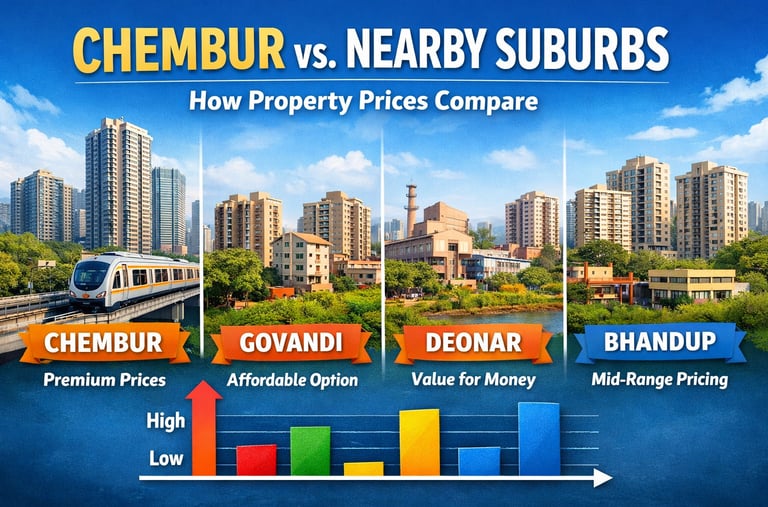
Chembur vs. Nearby Suburbs: How Property Prices Compare
Mumbai’s real estate market is defined by micro-locations, connectivity advantages, and lifestyle appeal. Among the city’s dynamic residential hubs, Chembur has emerged as a top choice for both homebuyers and investors. To better understand how Chembur stands relative to its neighbouring suburbs, property price trends and key market factors must be examined. This comparison explores Chembur’s pricing and demand alongside Govandi, Deonar, and Bhandup to give buyers and investors a clear picture of value for money.
8/21/20263 min read
Chembur: Strong Connectivity and Premium Appeal
Chembur’s strategic location in Mumbai’s eastern corridor makes it an attractive residential node. The suburb benefits from excellent connectivity through railway links, major arterial roads, and upcoming metro lines, which have boosted property demand.
Chembur’s property prices generally command a premium compared to nearby localities due to stronger social infrastructure, better road networks, and proximity to business hubs like BKC and Lower Parel. Properties with modern amenities and redevelopment features are particularly sought after. Mid-segment and premium homes in Chembur attract steady interest from families, young professionals, and long-term investors.
Govandi: Affordable Option with Growth Potential
Govandi lies adjacent to Chembur and is often viewed as a more affordable alternative for residential property buyers. Compared to Chembur, Govandi’s average property prices tend to be lower, making it attractive for first-time homebuyers or budget-focused investors.
While basic connectivity through local trains and roadways exists in Govandi, it lacks some of the seamless connectivity that Chembur enjoys. However, planned infrastructure upgrades and potential redevelopment initiatives are increasing interest in the area. For buyers willing to trade convenience for affordability, Govandi presents an opportunity to enter the eastern suburbs real estate market at a lower price point than Chembur.
Deonar: Industrial Heritage Meets Residential Transformation
Deonar is another neighbourhood close to Chembur with distinct characteristics. Traditionally known for its industrial zones, Deonar has been transforming with new residential developments and enhancing social infrastructure. Property prices here are generally lower than Chembur but can vary significantly based on exact location and project quality.
Compared to Chembur, Deonar is still developing its reputation as a mainstream residential destination. However, emerging projects with contemporary designs and enhanced amenities are attracting attention from value-focused buyers. Rental demand in Deonar also shows potential, though it remains more modest relative to Chembur due to commuting limitations and lower commercial infrastructure.
Bhandup: Established Suburb with Mid-Range Pricing
Further north of Chembur, Bhandup offers a mix of traditional neighbourhoods and newer residential developments. Traditionally known for industrial and manufacturing zones, Bhandup has diversified its real estate appeal with new residential projects, schools, and community facilities.
Property prices in Bhandup are often competitive when benchmarked against Chembur, particularly in mid-segment housing. Bhandup’s connectivity via local trains and road links to major employment hubs supports average property valuations that are slightly lower than Chembur but higher than Govandi and Deonar in some pockets. For buyers seeking balanced pricing with established social infrastructure, Bhandup is a viable alternative.
Comparative Price Insights
When comparing property prices across Chembur and its neighbouring suburbs, distinct trends emerge:
Chembur typically commands the highest prices among the group due to superior connectivity, ongoing redevelopment, and robust demand. Buyers are willing to pay a premium for convenience, lifestyle amenities, and better resale value.
Govandi presents the most affordable entry point into the eastern suburbs market, with lower price per square foot and potential for future appreciation as infrastructure improves.
Deonar offers lower-to-mid range pricing, with growing interest as social infrastructure expands and new residential projects are introduced.
Bhandup provides a competitive mid-range option, balancing accessibility to western and central Mumbai with relatively stable property valuations.
These comparisons are based on prevailing market patterns where connectivity, lifestyle demand, and redevelopment activity influence price differentials between suburbs.
Demand and Investment Outlook
Investor confidence in Chembur remains high due to consistent rental demand and promising long-term capital appreciation. Chembur’s appeal extends to professionals seeking proximity to business districts and families valuing community facilities.
Govandi and Deonar may appeal to investors seeking higher rental yields relative to entry cost, while Bhandup’s balanced ecosystem of social amenities and commuter access makes it attractive for both end users and portfolio investors.
As infrastructure projects mature and connectivity improves, price gaps between these suburbs may narrow, presenting new opportunities for strategic investment and homeownership.
Conclusion: Choosing the Right Suburb
Understanding how Chembur compares to nearby suburbs like Govandi, Deonar, and Bhandup allows buyers and investors to align their goals with the right location. Chembur stands out for premium pricing backed by strong demand, while its neighbouring areas offer diverse pricing options and potential growth. Whether the priority is affordability, long-term investment, or lifestyle convenience, each suburb has unique advantages worth evaluating in today’s evolving Mumbai real estate landscape.